
How To Measure Windows for Blinds and Curtains in Australia
Getting your window measurements right is one of the most important steps in buying new blinds or curtains. Order the wrong size and you are left with products that do not fit, light gaps that defeat the purpose, or fabric that pools awkwardly on the floor. Get it right and everything looks and works exactly as it should.
The good news is that measuring is straightforward once you understand the key decisions involved. This guide covers how to measure for roller blinds, curtains and other common blind types, so you can order with confidence.
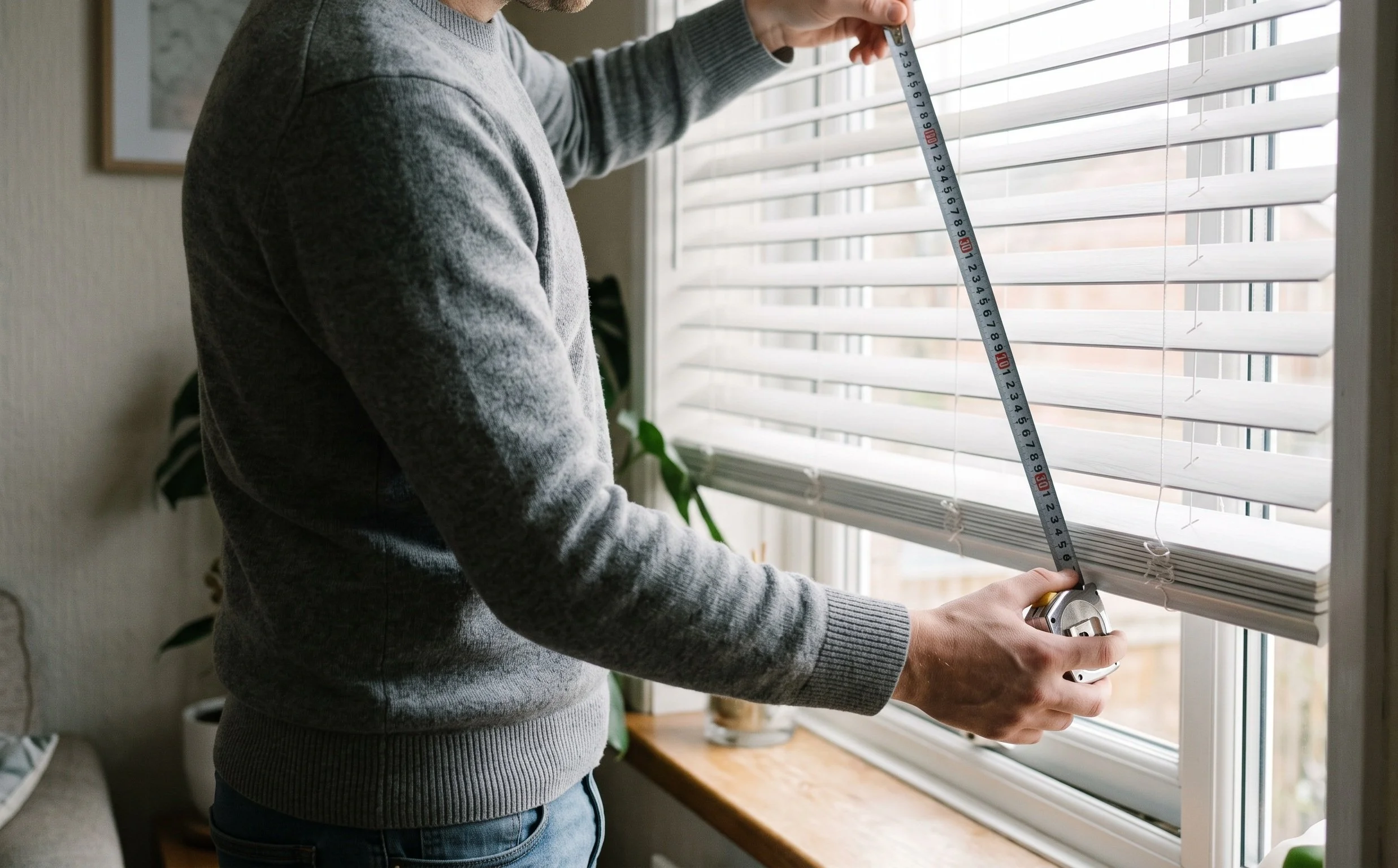
What you need before you start
Before taking any measurements, grab a steel tape measure. Fabric tape measures can stretch and give inaccurate results, so a rigid steel tape is essential. You will also need a pencil and paper to record each window separately, since windows in the same house often vary in size even when they look identical.
The other thing to decide before you measure is your mount type. This is the single biggest factor that affects how you measure, and it applies to both blinds and curtains.
Inside mount vs outside mount: what is the difference?
Inside mount (recess fit)
An inside mount means the blind or curtain sits inside the window recess. This gives a clean, minimal look that shows off your window frame and tiles. To install a blind inside the recess, your window will need a minimum depth of around 60mm from the glass to the front edge of the frame. Inside-mounted blinds will have a small light gap at the edges, which is normal.
Outside mount (face fit)
An outside mount means the blind or curtain is mounted on the wall or architrave above and outside the window frame. This is the better choice for light control, as the fabric can fully cover the frame and overlap on each side. Outside mounts also make windows look larger, which is a popular choice in smaller rooms.
If you are not sure which mount type suits your windows, our team can advise during a free in-home measure and quote.
How to measure for roller blinds
Roller blinds are available in blockout, light-filtering and sunscreen fabrics. Most roller blind fabric can be made up to 3000mm wide and 3000mm high, and some fabrics span up to 3200mm wide, making them suitable for almost any window.
Inside mount (recess fit)
Measure the width of the recess at the top of the window from left to right. Measure in three places, top, middle and bottom, and record the smallest measurement. This is the width you provide.
Measure the height from the top of the recess to the bottom in three places and record the smallest measurement.
Do not make any deductions yourself. When ordering through Bayside, the factory will make the appropriate allowances to ensure a neat fit inside the recess.
Outside mount (face fit)
Measure from the outer edge of the architrave on one side to the outer edge on the other for your width. To improve light control, add at least 50mm of overlap on each side beyond the architrave.
For the height, measure from where the bracket will sit above the window down to where you want the blind to finish. Adding 50mm above and below the frame helps eliminate light bleed around the edges.
A note on double roller blinds
If you want a blockout and sunscreen blind on the same window, Bayside can install a double bracket to hold both. Measure your window the same way as a single blind. The sunscreen blind sits at the back, closest to the glass, and the blockout blind sits at the front.
How to measure for curtains
Knowing how to measure a window for curtains is slightly different to measuring for blinds, because curtains are measured from the track or rod rather than the window frame itself. You need two key measurements: the width and the drop. It is important to install or mark the position of your hardware before you start measuring.
Curtains are the perfect option for addressing privacy without compromising on aesthetics, and getting the measurements right from the start ensures they hang beautifully.
Positioning your track or rod
For a professional look, mount your track or rod 10 to 15cm above the window frame. Going higher, closer to the ceiling, makes the room feel taller and the curtains appear fuller. Extend the track or rod 15 to 30cm past each side of the window frame so the curtains can stack clear of the glass when open.
Measuring the width
Measure the total length of your curtain track or rod from end to end. This is the foundation for your fabric width. Curtains need fullness to hang beautifully. As a general rule, the total fabric width should be 1.5 to 2.5 times the track width depending on the heading style. Pencil pleat curtains typically need 2 to 2.5 times the track width. Eyelet and wave headings need 1.5 to 2 times.
Measuring the drop
Measure from the bottom of your track or rod down to where you want the curtain to finish. Common options are:
Sill length: finishing at or just below the window sill, for a classic look in kitchens and bathrooms
Below sill: finishing 10 to 15cm below the sill, giving a slightly more relaxed look
Floor length: finishing just above the floor, around 10mm clearance, for a clean modern finish
Puddle: finishing 30mm or more on the floor for a luxurious, dramatic effect
Measure the drop in at least two places, left and right, and use the shorter measurement. Floors can be uneven, particularly in older Illawarra homes, so checking multiple points is important.
How to measure for vertical blinds
Vertical blinds are ideal for large windows and sliding doors. Measure the same way as roller blinds, using the inside or outside mount method depending on your preference.
For an inside mount, measure the width and height of the recess and record the smallest measurements in each direction. For an outside mount, measure the full area you want covered, adding overlap on each side and above to minimise light gaps.
How to measure for other blind types
The same inside mount and outside mount principles apply to most other blind types including Roman blinds, cellular and pleated blinds, Veri Shades and panel glide blinds. For each, measure the width in three places and the height in three places, and record the smallest measurement in each direction.
For Roman blinds in particular, consider whether you want the fabric to sit within the recess or frame the window from the outside, as this affects how the folds look when the blind is raised.
For Veri Shades and panel glide blinds, which are designed for wide openings and sliding doors, measure the full width of the opening including any overlap you want on each side, and the full height from floor to ceiling or to your preferred drop point.
Tips for measuring accurately
Always use a steel tape measure, never a fabric one. Measure each window individually, even if they look the same. Record measurements in millimetres for precision. Measure width and height in three places each and use the smallest figure. Double-check before ordering, as custom-made blinds and curtains cannot be adjusted once produced.
Why professional measure and quote makes sense
While measuring yourself is entirely possible, there is a lot that can affect the outcome: window frames that are not square, architraves that vary in depth, or the interaction between two blinds on a double bracket. Getting it wrong means products that do not fit, and with custom-made window furnishings, that can be a costly mistake.
At Bayside, every installation begins with a free in-home measure and quote. One of our team will visit your home across Wollongong and the Illawarra, take precise measurements, walk you through the options and leave you with a written quote on the spot.
Why choose Bayside for your blinds and curtains?
At Bayside Security Doors and Blinds, we have been helping families across Wollongong and the Illawarra choose the right window treatments since 1989. We supply and install a full range of interior blinds, curtains and plantation shutters, alongside our core security screen products. Every product is custom-measured and fitted to your home.
We hold a Master Security Licence (410068622) and are members of NSSA and ASIAL. Every job comes with a workmanship guarantee, and we start with a free, no-obligation measure and quote at your home.
Whether you need a single blind or want to outfit your entire home, our team can guide you through the options that suit your lifestyle and budget.
Book a free measure & quote
Call (02) 4271 1955 or book through our contact form. We will visit your home, walk you through the options, and leave you with a written quote on the spot. No obligation, no charge.
Call Now: (02) 4271 1955
Frequently Asked Questions
-
Decide whether you want an inside mount or outside mount first. For an inside mount, measure the width and height of the window recess in three places each and record the smallest measurements. For an outside mount, measure the full area you want covered, adding overlap on each side and above the frame to minimise light gaps. Always use a steel tape measure and record measurements in millimetres.
-
For an inside mount roller blind, measure the width of the recess at the top, middle and bottom and use the smallest figure. Measure the height on the left, centre and right and use the smallest figure. For an outside mount, measure the full width you want covered including overlap, and the height from the bracket position to where you want the blind to finish. Do not make deductions yourself as the factory will allow for fit.
-
Curtains are measured from the track or rod, not the window frame. Mount or mark your track position 10 to 15cm above the window frame and extending 15 to 30cm past each side. Measure the total track length for your width basis, then multiply by 1.5 to 2.5 depending on the heading style for your fabric width. For the drop, measure from the bottom of the track to where you want the curtain to finish.
-
Install or mark your curtain track or rod before measuring. Mount it 10 to 15cm above the window frame and extend it 15 to 30cm past each side. Measure the full track length for your width and multiply by 1.5 to 2.5 for your fabric width depending on the heading style. For the drop, measure from the bottom of the track down to where you want the curtain to finish, taking measurements on both the left and right and using the shorter figure.
-
An inside mount sits within the window recess for a clean, minimal look. An outside mount is installed on the wall or architrave above and outside the frame, giving better light control and making windows appear larger. Inside mounts require a minimum recess depth of around 60mm and will have a small light gap at the edges, which is normal.
-
For an outside mount blind, it is generally recommended to add at least 50mm of overlap on each side of the window frame and 50mm above and below. This helps block light around the edges and gives the blind a fuller, more proportionate look.
-
The total fabric width of your curtains should be 1.5 to 2.5 times the width of your track or rod depending on the heading style. Pencil pleat curtains need the most fullness at around 2 to 2.5 times, while eyelet and wave headings work well at 1.5 to 2 times. The track itself should extend 15 to 30cm past each side of the window frame.
-
You can measure your own windows, and this guide gives you everything you need to do it accurately. That said, custom-made blinds and curtains cannot be altered after production, so if you are not confident or your windows are uneven, a professional measure is the safer choice. At Bayside, our free in-home measure and quote service takes the guesswork out of the process entirely.